


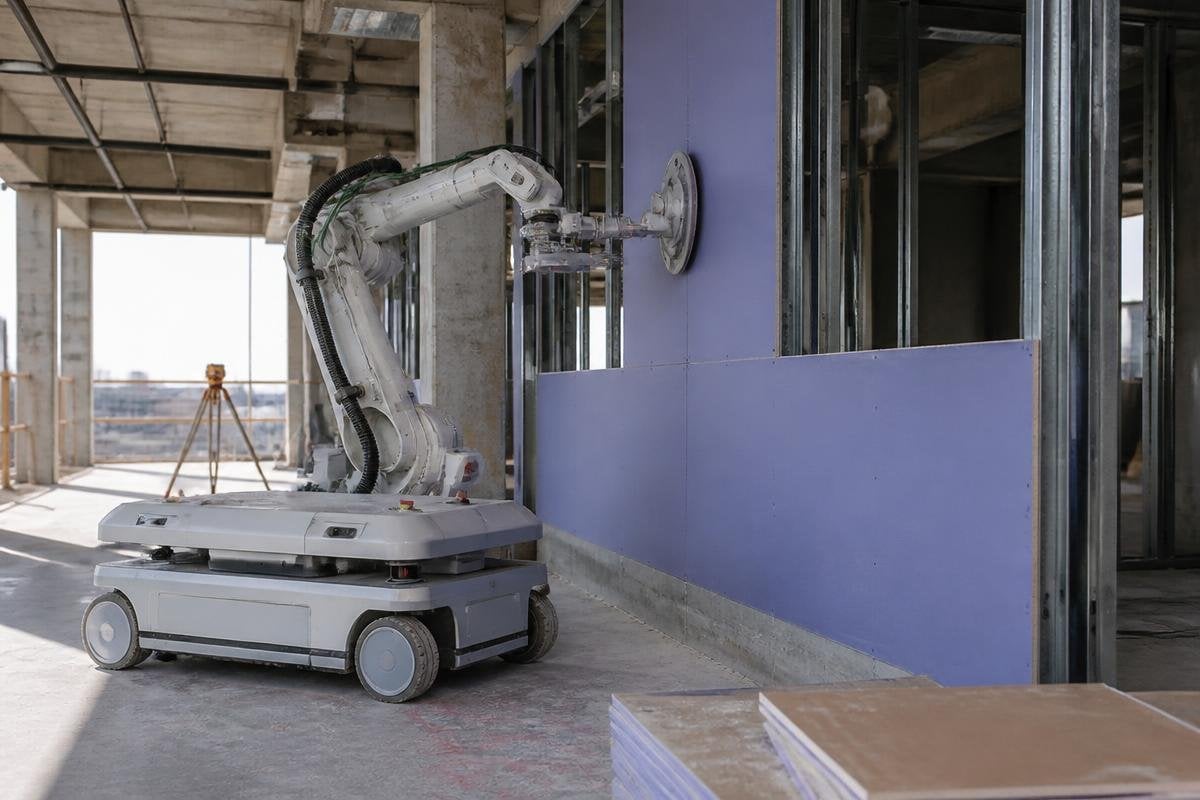
Construction robots are taking on work that is repetitive, dangerous, or easier to control away from a busy job site. The change is practical: some tasks move to factories, while others gain machines that measure, carry, cut, or place materials.
Quick read
- Robots can work from CAD files, LiDAR scans, and GNSS coordinates.
- Prefabrication gives machines a more controlled setting than an open site.
- Human crews still handle setup, judgment, repair, and many changing conditions.
Where robots fit first
The easiest construction tasks for robots have a clear target and a repeatable motion. A robotic arm can cut panels or place materials when the work area stays within known limits. A mobile robot can carry supplies across a site when its route is mapped and kept clear.
That makes measurement an early use for automation. A robot with cameras or LiDAR can record walls, floors, and other site features. The scan can then be compared with a computer-aided design (CAD) file, which gives the project team a way to find errors before later work depends on them.
The value depends on what happens after the scan. A pile of accurate data does little if nobody checks it against the build plan or changes the next task. The machine has to fit a work process, not sit beside one.
Factories make robot work easier
Construction has a difficult setting for machines. Ground changes, materials arrive late, weather affects surfaces, and people move through the same space. A factory removes some of those variables, so robots can repeat a task with fewer changes around them.
That is why robotic fabrication matters. Wall sections, building components, and other parts can be made in a controlled area, then moved to the site for assembly. The site crew spends less time on repeated cutting or placement and more time fitting parts, checking connections, and handling work that cannot be planned in advance.
This approach also changes the skills a project needs. Workers may spend less time repeating one motion and more time reading digital plans, setting machine paths, checking tolerances, and fixing faults. The work remains physical, but the source of the instructions moves closer to software and measurement.
The limits are still on the site
A robot that works well on a prepared floor may struggle on loose ground, around scattered tools, or beside people who change direction without warning.
Construction sites change daily, which makes a fixed route or fixed arm position harder to maintain.
Materials create another limit. A machine may handle one panel or block in a test setup, yet need new gripper settings when the size, surface, or weight changes. Dust, vibration, rain, and poor lighting can also reduce the quality of camera and sensor data.
The safety plan matters as much as the robot. A project needs clear work zones, stop controls, inspection steps, and a person who can take over when the machine meets a condition its software does not cover. The machine may reduce exposure to a hazard, but it doesn’t remove the hazard from the site.
A robot’s task can change when the ground shifts or another crew enters its work zone. Dated construction reporting at Robot24.com lets a project team compare the machine’s stated job with its recorded limits. Those details set up the checks below.
What a project team should check
Before adding a robot to a construction process, check these points:
- Name the task: write down the exact motion, material, and finish the machine must handle.
- Map the setting: record floor conditions, access routes, people, lighting, dust, and weather.
- Check the handoff: decide who loads materials, reviews the result, and fixes errors.
- Price the full setup: include software, training, guards, maintenance, transport, and downtime.
- Set a human stop rule: define the conditions that pause the robot and return control to a worker.
The strongest projects will start with a narrow task and a clear measure of success. A team might track rework, time per part, inspection errors, or worker exposure to a risky step. Without that measure, a robot can look busy while the project gains little.
I’d start with work that repeats often and causes a known delay, then expand only after the numbers hold on a live site. Construction robots will change the industry through many small handoffs, and the next useful question is which task your crew can measure well enough to give to a machine.